Supporting Case · Smart-Home Interaction
Smart-Home Access, Trust, and Everyday Reliability
Examining how biometric sensing, household roles, and feedback clarity shape trust in everyday smart-home access.
Role
IxD Designer · Cross-functional team
Type
Smart-Home IxD / HCI
Date
May – Nov 2024

A household smart lock functions less as a single hardware product and more as a recurring system for negotiating identity, permission, and trust at the door.
Overview
Xiaomi Mi Door Lock M30 Pro is a consumer smart-lock system built for time-sensitive household access scenarios. Rather than treating the lock as a single security mechanism, this case reframes it as a physical-digital interaction system: a recurring sequence of biometric sensing, app-based control, temporary access delegation, and household coordination that has to remain usable across very different people — children, visitors, and older household members among them. As part of a cross-functional product team, I contributed interaction-design work spanning touch-target calibration, panel layout, child-safety mechanisms, and companion-app workflows, while biometric algorithms and backend performance metrics were owned by the engineering team. This page focuses on where physical sensing, feedback design, and household role differences created friction during development, and how those breakdowns connect to broader questions about trust and continued use of everyday household technology.
Research Question
Where do everyday smart-home access systems break down for different household members, and what does that reveal about the relationship between biometric sensing reliability, interaction feedback, and trust in continued technology use?
Why This Case Matters
Household access systems are an everyday, low-visibility test of whether a technology remains usable as a person's physical abilities, confidence, or household role changes over time. The breakdowns observed here — ambiguous feedback, sensing failures, maintenance anxiety, and safety-convenience tradeoffs — suggest a broader pattern that may also appear in household and personal technologies relevant to older adults' digital inclusion. Older household members are one segment studied in this project, not its sole focus, but the access-journey framing developed here connects to that broader research interest.
Supporting applied case. The flagship research project is the hearing-aid self-fitting study.
| Case dimension | Description |
|---|---|
| Technology context | Consumer smart-home access device (Xiaomi Mi Door Lock M30 Pro), part of a broader connected smart-home ecosystem |
| User setting | Everyday residential households with varying composition — multi-generation families, couples, and individuals living alone |
| Stakeholders | Household members (including children and older residents), visitors, delivery couriers, product and engineering team |
| Main interaction risk | Access failure or ambiguity at a safety-critical, time-sensitive moment (entering or leaving the home) |
| Research contribution | Frames household access as a physical-digital interaction problem rather than a purely mechanical or security problem |
Safe role statement: I contributed to this project as a UI/UX and interaction designer within a cross-functional team that also included product management, industrial design, and engineering. Biometric algorithm development and backend system performance were owned by the engineering team and are not represented as individual work on this page.
Research Context / Evidence Base
Investigating Household Access Needs Across Methods
The investigation phase situated the smart lock within its broader smart-home context and combined professional requirements, external evidence from reviews and social comments, and direct research through in-home observation and technical scoping — before any interaction design began. Review mining then identified clustered complaint patterns pointing to systemic reliability concerns rather than isolated defects, while in-home research added context that reviews alone could not provide. Persona segmentation represented differences in household composition and access needs, with the older-couple persona as one segment among several.
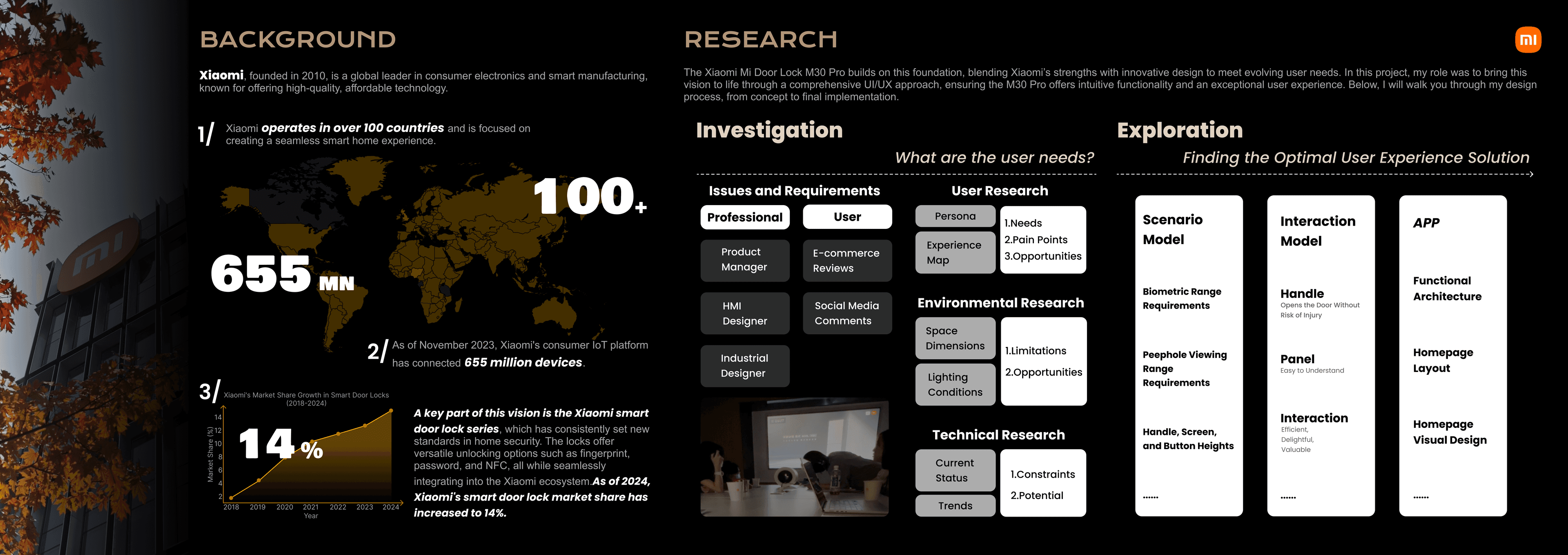
The research process combined internal product requirements with external user evidence and direct household observation before any interaction design began.
| Research input | Design relevance |
|---|---|
| Professional requirements (PM, HMI, industrial design) | Defined feasibility constraints and cross-functional priorities that interaction design had to work within |
| E-commerce reviews | Surfaced recurring complaint patterns from existing smart-lock products in the market |
| Social media comments | Added informal, unprompted accounts of everyday frustration not captured in structured reviews |
| In-home research | Grounded findings in real household routines, space constraints, and lighting conditions |
| Environmental constraints | Identified physical limitations shaping where and how sensing could occur |
| Technical constraints | Clarified current system capabilities and limits before scenario and interaction modeling began |
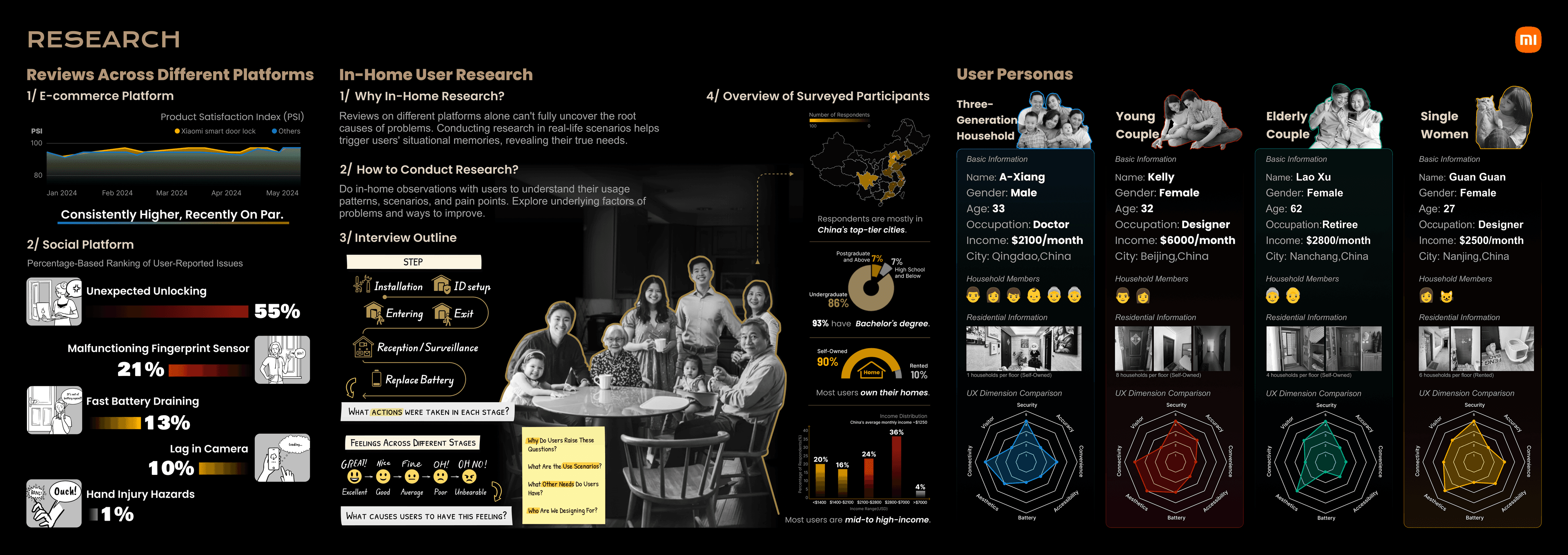
Complaint patterns from public reviews were combined with in-home observation to build a household-level, rather than device-level, picture of access reliability.
| Evidence source | What it revealed | Interaction implication |
|---|---|---|
| E-commerce reviews | Recurring complaint clusters (unexpected unlocking, fingerprint-sensor failure, battery drain, camera lag) | Suggested reliability and feedback issues were systemic, not isolated to one model or use case |
| Social media complaints | Informal, narrative accounts of frustration in real use | Highlighted emotional dimensions of access failure not visible in star ratings |
| In-home observation | Real household routines, installation behavior, and entry patterns | Showed that access problems often arise from environment and habit, not only device defects |
| Persona segmentation | Distinct access priorities across household types | Established that "the user" of a smart lock is not a single profile but a household of differently positioned people |
Household Personas
| Persona | Key access concern |
|---|---|
| Three-generation household | Coordinating access and permissions across age groups, including child-safety constraints |
| Young couple | Convenience and confidence in everyday, fast-paced unlocking |
| Older couple | Reliability of biometric recognition and clarity of feedback during entry |
| Single women | Personal safety and confidence when managing visitors or deliveries alone |
Access Journey
Reframing Unlocking as a Multi-Stage Access Journey
Mapping household access as a sequence of stages — installation, ID setup, unlocking, entry, temporary access, app use, and battery/maintenance — revealed that pain points are distributed across the entire experience, not concentrated at the moment of unlocking. This framing suggests that trust in the system is shaped cumulatively by repeated minor breakdowns across setup, daily use, and maintenance, rather than by any single point of failure.
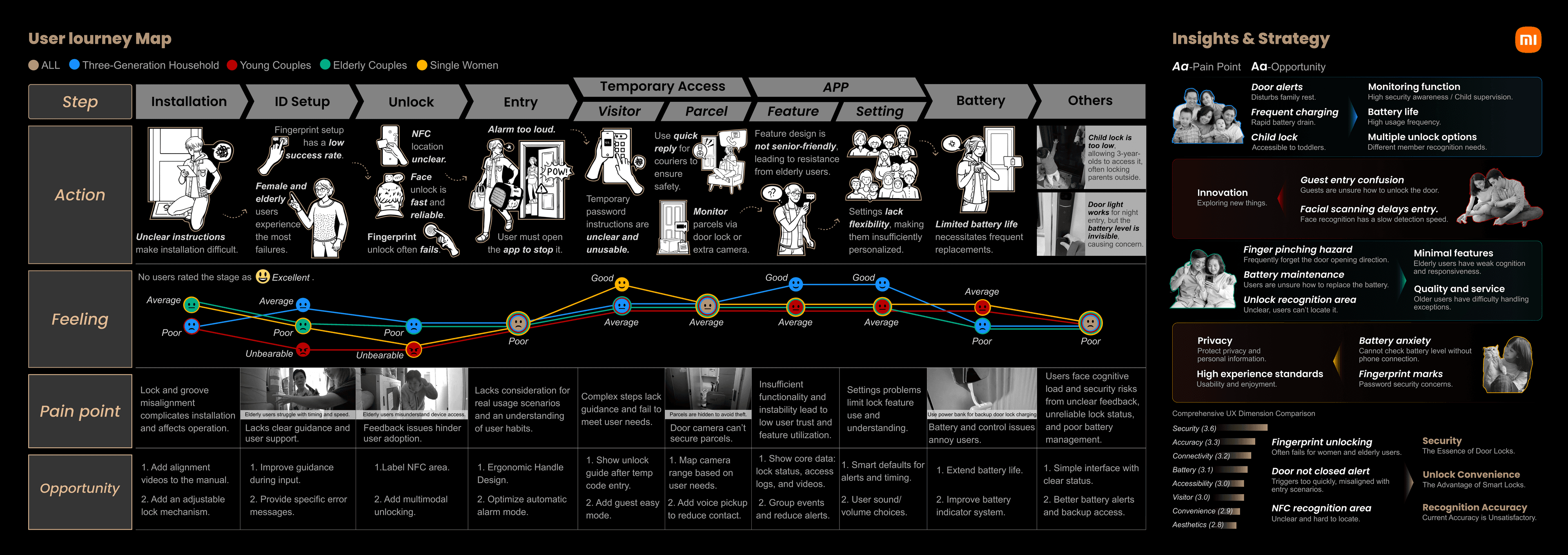
Treating access as a multi-stage journey revealed that trust erodes gradually, through small frictions accumulated across setup, daily use, and maintenance.
| Journey stage | Breakdown observed | Design opportunity |
|---|---|---|
| Installation | Unclear instructions and physical misalignment complicated setup | Clearer guidance materials and more forgiving mechanical tolerances |
| ID setup | Inconsistent success rates across fingerprint, face, and NFC enrollment | More explicit, modality-specific setup guidance and error feedback |
| Unlock | Inconsistent recognition performance across different users | Sensing and feedback improvements informed by usability testing |
| Entry | Alarms or feedback cues perceived as unclear or excessive | Calibrated alert thresholds and clearer status communication |
| Temporary access | Visitor and courier access steps seen as unclear or insecure | Simplified, better-guided temporary-access flows |
| App use | Interface elements seen as not accommodating to all users | Review of information density and clarity in app screens |
| Battery / maintenance | Frequent charging needs and unclear battery status created anxiety | Status visibility and extended-life design priorities |
Sensing & Feedback
Calibrating Touch Sensing for Reliable Feedback
Usability-informed prototype testing examined how sensing-area size, sampling rate, and key spacing affected the tradeoff between responsiveness and accuracy on the physical keypad interface. This was product-development evaluation aimed at reducing "no response after pressing" and false-triggering issues identified earlier in the journey map — not a controlled or peer-reviewed study of touch perception.
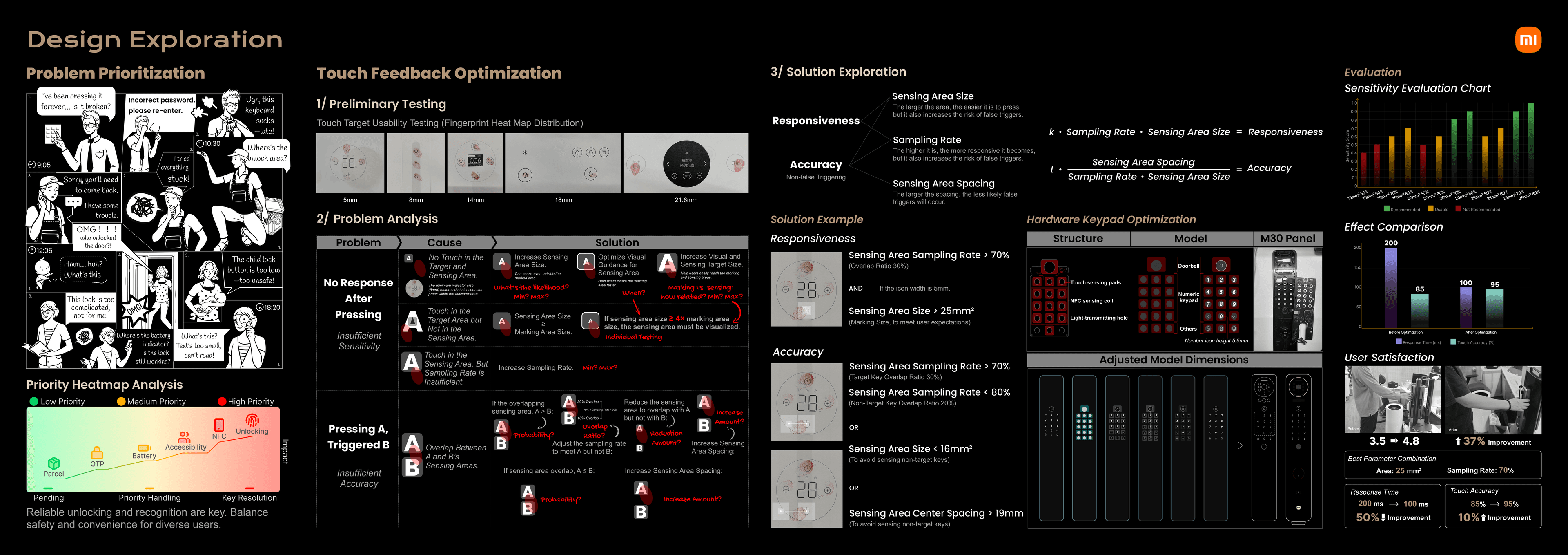
Prototype testing of sensing-area size, sampling rate, and spacing was used to balance responsiveness against accuracy on the physical keypad.
| Interaction variable | Design question | Why it matters |
|---|---|---|
| Sensing area size | How large must a touch target be to register reliably without overlapping neighbors? | Directly affects whether a press is registered at all |
| Sampling rate | How frequently should the sensor poll to balance responsiveness against false triggers? | Higher rates improve responsiveness but raise false-trigger risk |
| Sensing area spacing | How much separation between targets prevents adjacent-key misreads? | Reduces "pressing A, triggered B" errors |
| Response time | How quickly should the system confirm a registered press? | Slow feedback reads as unresponsiveness, eroding confidence |
| Touch accuracy | How consistently does the system register the intended key? | Core driver of perceived reliability during everyday use |
| False triggering | How often does the system register unintended input? | Source of the "unexpected unlocking" complaint pattern identified in review mining |
Described here as usability-informed, product-development optimization — not as clinical or scientific validation of touch sensing.
Panel, Safety & App
Balancing Recognition Clarity, Child Safety, and App Feedback
Three parallel design problems were addressed across this phase: making the physical panel legible and the NFC recognition area clear at a glance; designing a child-lock mechanism that resists accidental activation without burdening adult users; and ensuring that the companion app reflected device state consistently, reducing the gap between physical and digital feedback. Adult operation time, child accidental-touch rate, and satisfaction scores were used as internal, comparative product-development indicators — not as generalizable usability findings.
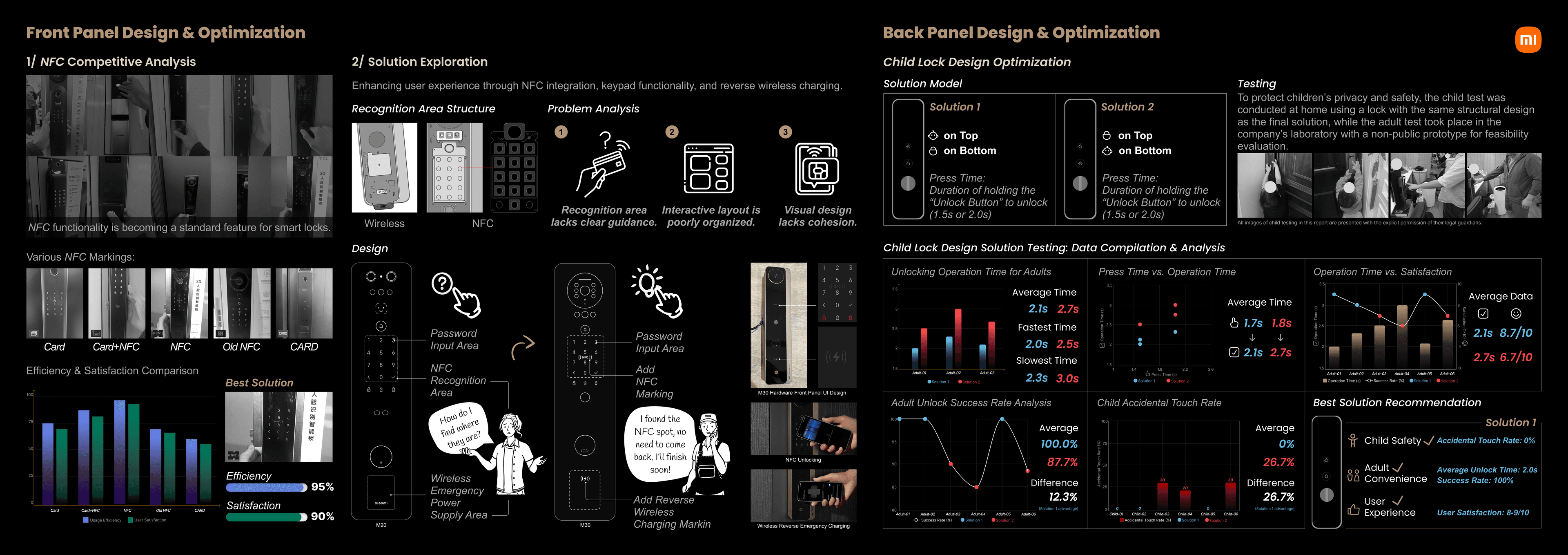
Front- and back-panel iteration treated recognition clarity and child safety as a single design problem, evaluated through comparative, product-development testing.
| Design problem | Option explored | Evaluation criterion |
|---|---|---|
| NFC recognition area unclear | Added explicit visual marking and icon guidance for the NFC zone | Comparative efficiency and satisfaction across marking approaches |
| Input layout poorly organized | Restructured password, NFC, and emergency-power zones into a clearer hierarchy | Ease of locating the correct interaction zone |
| Child lock location | Compared top- vs. bottom-mounted button placements | Adult unlocking time and child accidental-touch rate |
| Press duration | Compared short- vs. extended-hold activation timing | Balance between accidental activation and intentional control |
| Adult vs. child safety tradeoff | Selected the option minimizing child accidental touch without materially slowing adult unlock time | Combined safety, convenience, and reported user confidence |
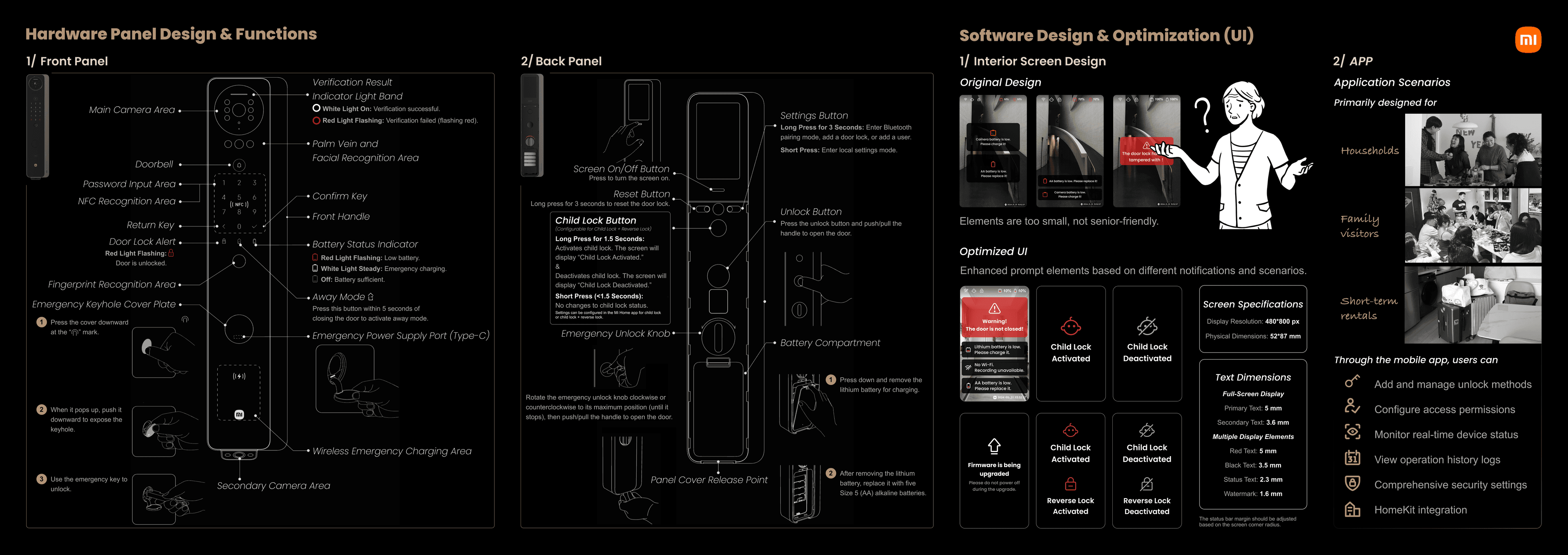
Physical-digital reliability depends on the device and the app communicating status and feedback consistently, not on either channel alone.
| Interface layer | Function | Reliability concern |
|---|---|---|
| Front panel | Biometric and password input, verification feedback, doorbell, emergency access | Must communicate verification outcome clearly and immediately |
| Back panel | Settings, reset, child lock, emergency unlock, battery access | Must remain usable without exposing critical controls to misuse |
| Interior screen | In-home status prompts (e.g., low battery, door not closed, firmware update) | Text and icon sizing must remain legible at a glance under real conditions |
| Mobile app | Remote access control, permissions, real-time status | Must reflect true device state without lag or ambiguity |
| Notification system | Alerts for tampering, low battery, connectivity issues | Must distinguish urgent from routine notifications to avoid alert fatigue |
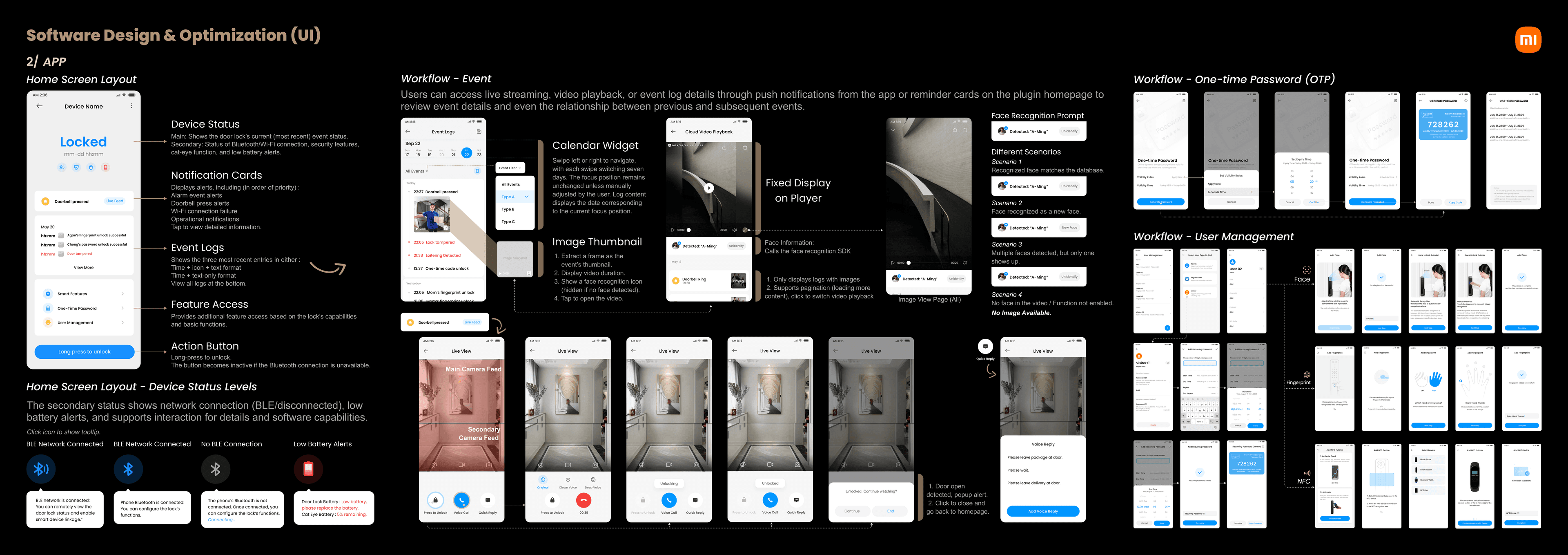
The app extends access governance beyond the door, letting household members delegate, monitor, and review access remotely.
| App function | Household access value |
|---|---|
| Device status | Lets users confirm lock state and connectivity without being at the door |
| Notification cards | Surfaces alerts (tampering, low battery, door not closed) in order of urgency |
| Event logs | Provides a reviewable record of who accessed the home and when |
| One-time password | Supports temporary, time-limited access for visitors or service providers |
| User management | Lets household members assign and adjust access permissions for others |
| Camera / event review | Allows visual confirmation of who triggered an access event |
Final System / Takeaway
Final Product System as Implementation Evidence
These boards present the shipped system — multiple biometric and credential-based unlocking methods, dual-camera and radar-based monitoring, app-based management, and smart-home interconnection — as evidence that the earlier research and design work was carried through to implementation. They are presented as outcome documentation, not as independent proof that the system performs reliably or accessibly in the field.
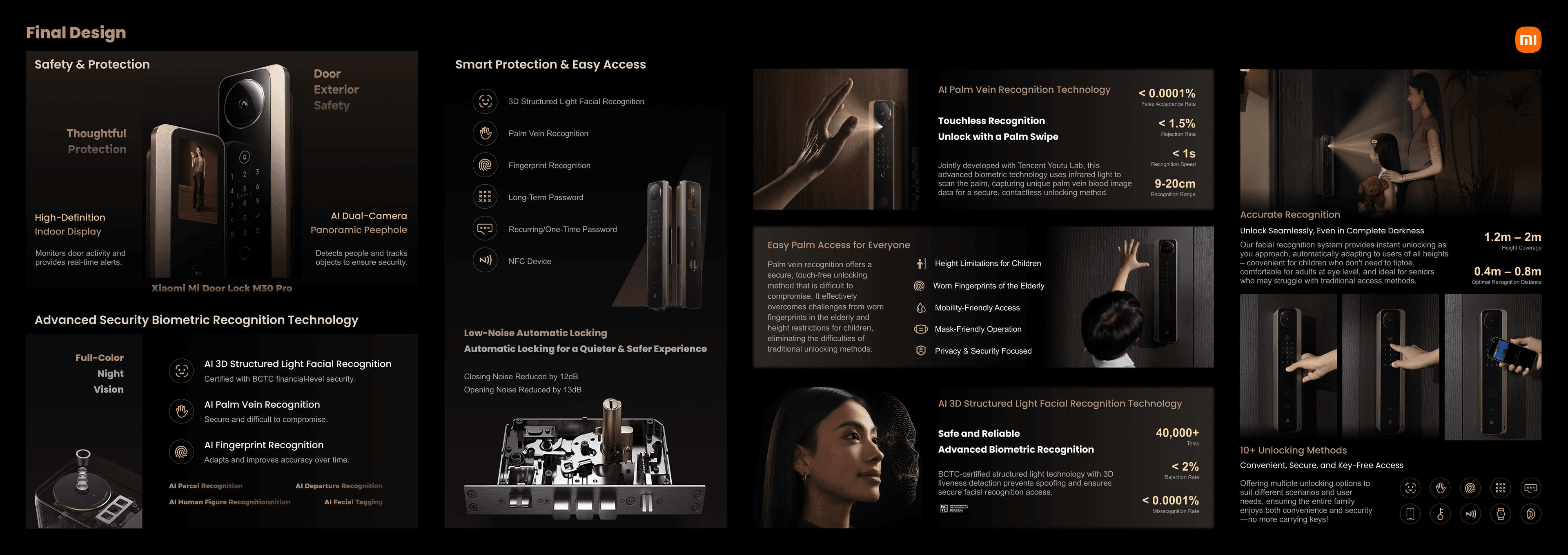
The final system documents implementation outcomes from the design process.
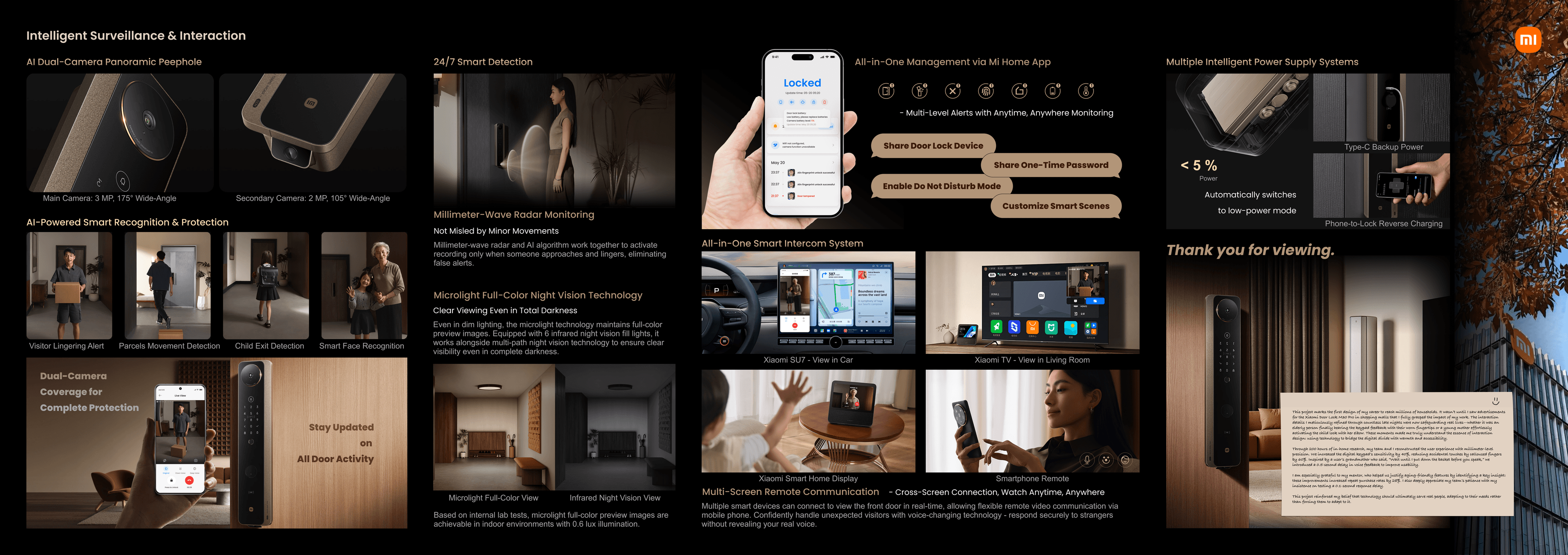
It is not presented as independent evidence of real-world reliability or accessibility.
| Final system feature | Research relevance |
|---|---|
| Multiple unlocking methods | Reflects the project's response to varied household needs and biometric failure modes identified earlier |
| Palm vein / face / fingerprint recognition | Represents engineering-led biometric implementation building on interaction and panel design constraints |
| Camera and radar monitoring | Extends access awareness beyond the moment of unlocking, addressing visitor and parcel scenarios from research |
| App-based management | Operationalizes the permission and review functions explored in the app workflow section |
| Backup power / power alerts | Addresses the battery-anxiety pain point identified in the user journey |
| Smart-home integration | Situates the lock within the broader ecosystem context established in the background research |
Access Breakdown Taxonomy
| Breakdown mechanism | Example from M30 | Broader relevance |
|---|---|---|
| Biometric / sensing uncertainty | Inconsistent fingerprint or facial recognition performance across users | Recurs wherever biometric or physical sensing must accommodate varied bodies and conditions |
| Feedback ambiguity | Unclear alarms, indicator lights, or "no response after pressing" moments | A general risk wherever device state is not clearly communicated to the user |
| Household role complexity | Differing access needs across children, visitors, and household members | Relevant to any shared technology mediating access or permission within a household |
| Safety-convenience tradeoff | Child-lock placement balancing accidental activation against adult convenience | A recurring design tension in technologies serving multiple user types at once |
| Maintenance anxiety | Uncertainty about battery status and replacement timing | Parallels concerns about upkeep and reliability in other personal and household technologies |
| App-device discontinuity | Gaps between physical-panel state and app-reported status | A general risk in any system spanning a physical device and a companion app |
| Trust and perceived reliability | Cumulative effect of small failures across the access journey reducing confidence | Central to research on continued technology use and digital inclusion |
Research Takeaway
Smart-home access is not only a security feature — it is a household interaction system that has to remain trustworthy across very different users and routines. This case illustrates how breakdowns in that system emerge across several layers at once: physical sensing uncertainty, ambiguous feedback, shifting household roles, safety-convenience tradeoffs, and ongoing maintenance demands such as battery anxiety. None of these breakdowns is unique to smart locks, and none is reducible to a single technical defect; together they shape whether people continue to trust and use a household technology over time. This case complements my hearing-aid self-fitting work by showing that interaction breakdowns also appear in everyday household infrastructure, where sensing, feedback, permissions, and maintenance shape whether people continue to trust and use a technology.
This final system is presented as evidence of product-development translation, not as independent validation of security or accessibility outcomes. Implementation details, internal performance metrics, and proprietary specifications are omitted or generalized due to commercial confidentiality.
This page is not an official Xiaomi publication. Material shown reflects publicly presentable project documentation only.